Posted about 2 months ago
Tags: #Research, #Discussion
Zakey Groot
@zakey_groot · about 2 months ago
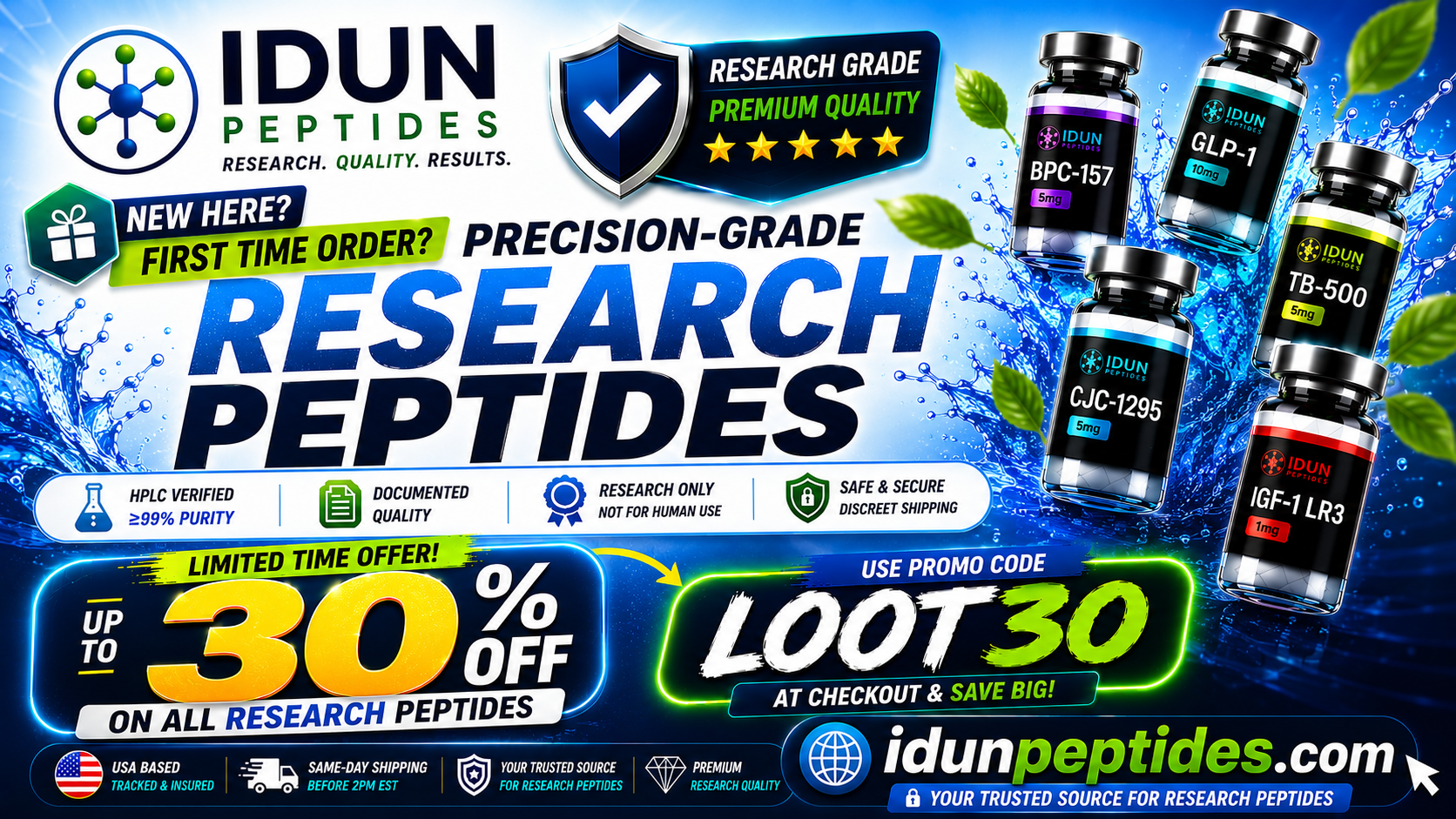
Use promo code LOOT30 for up to 30% off eligible IDUN Peptides purchases. TB-500 and BPC-157 are often discussed together, but they are different research compounds with different structures, research histories, and analytical considerations.
The easiest mistake to make with these two peptides is treating them as interchangeable.
They aren't.
BPC-157 is a defined 15-amino-acid synthetic peptide, while the name TB-500 has been used inconsistently in the research market. Scientific literature has described TB-500 in connection with a short N-terminally acetylated fragment of thymosin beta-4, while some current suppliers use the name for full-length thymosin beta-4, which is 43 amino acids long.
That naming issue isn't a technical footnote.
It can materially change what a researcher believes they're comparing.
This guide focuses on the scientific and sourcing distinction between BPC-157 and TB-500, how the research literature differs, why the names cause confusion, and what to verify in a research supplier's documentation.
If IDUN meets your laboratory's sourcing requirements, you can check its current research catalog and use LOOT30 for up to 30% off eligible purchases.
BPC-157 vs TB-500 at a glance
CharacteristicBPC-157TB-500Basic identitySynthetic pentadecapeptideName used inconsistently in research marketLength15 amino acidsCan refer to a shorter fragment or full-length thymosin beta-4, depending on supplierResearch contextBroad preclinical researchThymosin beta-4 / actin-related research and fragment studiesMajor research themesTissue repair, gastrointestinal models, angiogenesis and signalingActin biology, cell migration, tissue-repair modelsIdentity challengeRelatively clear molecular identityImportant naming ambiguitySupplier-check priorityConfirm BPC-157 identity and batchConfirm exactly which TB-500 material is being soldHuman clinical evidenceLimitedLimited and especially difficult to interpret for fragment productsRegulatory concernResearch-stage compoundFDA has specifically raised safety concerns about TB-500 fragment materials
The biggest takeaway from the table is simple:
BPC-157 is a clearly defined peptide. TB-500 requires an extra identity check.
What is BPC-157?
BPC-157 is a synthetic 15-residue peptide, commonly described as a pentadecapeptide.
The current research literature describes it as a sequence associated with a peptide fragment found in gastric secretions, and it has been investigated extensively in preclinical models. A recent 2026 review characterizes BPC-157 as an investigational peptide with more than three decades of preclinical research, while noting that its clinical development remains limited.
The research literature includes studies examining:
Gastrointestinal models
Tissue repair
Angiogenesis
Vascular responses
Musculoskeletal models
Inflammatory pathways
Neurological models
Other experimental biological systems
That broad literature is one reason BPC-157 and TB-500 are often mentioned together.
But they are not the same molecule and should not be treated as interchangeable research reagents.
What is TB-500?
This is where the comparison gets much more interesting.
TB-500 is not always used to mean the same molecular entity.
A 2012 analytical study identified an N-terminally acetylated 17–23 fragment of thymosin beta-4, Ac-LKKTETQ, in a formulation described as TB-500. The researchers characterized that fragment using high-performance liquid chromatography and mass spectrometry.
At the same time, some current research suppliers use the name TB-500 for full-length thymosin beta-4, a 43-amino-acid peptide. IDUN's current TB-500 page explicitly states that its product is full-length thymosin beta-4, 43 amino acids long, and distinguishes it from the shorter fragment commonly associated with the TB-500 name.
So before comparing two products labeled “TB-500,” ask:
What exact sequence is being supplied?
That may be more important than the product name itself.
The TB-500 naming problem explained
This is the most important section for anyone researching TB-500.
Consider three descriptions:
TB-500 as a shorter fragment
A 2012 analytical paper identified the N-terminally acetylated 17–23 fragment of thymosin beta-4, Ac-LKKTETQ, in a TB-500 formulation.
Thymosin beta-4
The parent molecule is a 43-amino-acid peptide with a well-established role in actin biology. Classic biochemical work established thymosin beta-4 as an actin-sequestering peptide.
TB-500 as a supplier product name
Some current suppliers now use “TB-500” for full-length thymosin beta-4. IDUN explicitly says its TB-500 product is the full-length 43-amino-acid form.
These distinctions mean that two products carrying the same commercial name may not be molecularly identical.
For a researcher, that is a COA and identity-testing issue, not just a naming issue.
BPC-157 vs TB-500: structural differences
The molecules start from very different places.
BPC-157
BPC-157 is a defined 15-amino-acid synthetic peptide.
Its identity can therefore be described by a specific sequence, molecular mass, and analytical profile.
TB-500
TB-500 requires more careful terminology.
Depending on the supplier or source, it may refer to:
A shorter thymosin beta-4-derived fragment
Full-length thymosin beta-4
A research-market product name that does not make the sequence immediately obvious
That means the phrase:
“TB-500 vs BPC-157”
isn't quite complete without first specifying which TB-500 molecular form is being discussed.
Why the distinction matters for research
Imagine two laboratories compare:
Lab A: BPC-157 vs a seven-residue thymosin beta-4 fragment
Lab B: BPC-157 vs full-length thymosin beta-4
Those aren't the same comparison.
The molecular mass is different.
The amino-acid sequence is different.
The biochemical context is different.
The expected analytical profile is different.
And the scientific literature being used to support the comparison may also be different.
This is why identity confirmation should come before mechanism comparisons.
What does the research literature say about BPC-157?
Recent reviews describe BPC-157 as having a broad preclinical literature spanning several biological systems.
A 2026 narrative review emphasizes the difference between extensive preclinical activity and limited clinical development. It notes that BPC-157 has no approved formulation, no validated dosing regimen, and no completed Phase II clinical trial identified in its review.
That means the literature is most useful for understanding:
Experimental mechanisms
Animal-model findings
Cellular responses
Pharmacological hypotheses
Research questions that remain unresolved
It should not automatically be converted into claims about established human efficacy.
What does the research literature say about thymosin beta-4?
Thymosin beta-4 has a different scientific history.
It is a naturally occurring peptide associated with actin sequestration and cytoskeletal regulation. Classic biochemical research demonstrated that thymosin beta-4 binds actin and influences actin polymerization dynamics.
That gives thymosin beta-4 a very different mechanistic starting point from BPC-157.
Rather than treating both as generic “healing peptides,” it is more scientifically useful to think about:
BPC-157 → signaling / vascular / tissue-response research
Thymosin beta-4 → actin / cell-migration / cytoskeletal research
Those are broad research lenses, not claims that either compound produces a particular outcome in humans.
BPC-157 vs TB-500: research themes
A practical comparison looks like this:
Research themeBPC-157TB-500 / thymosin beta-4 contextGastrointestinal researchProminentMuch less centralAngiogenesis-related researchProminentPresent in thymosin beta-4 literatureActin biologyNot the defining research themeCentral to thymosin beta-4Cell migrationStudiedMajor thymosin beta-4 research themeTissue-repair modelsBroad preclinical interestBroad preclinical interestStructural ambiguityLowerHigher when “TB-500” is used without sequence detailsAnalytical identity challengePrimarily routine peptide verificationEspecially important because of naming ambiguity
This is a better comparison than asking which peptide is simply “stronger.”
The scientific questions are different.
Is BPC-157 better than TB-500?
There is no scientifically reliable universal answer.
The compounds are different.
Their research histories are different.
The evidence bases are different.
And “TB-500” itself can refer to different molecular forms.
A researcher should therefore choose based on the research question and the exact material required, not on generalized internet claims that one compound is automatically better.
Is TB-500 the same as thymosin beta-4?
Not necessarily.
This is one of the most important answers in the entire article.
Some sources use TB-500 as a name for a thymosin beta-4-derived fragment. A published analytical paper identified Ac-LKKTETQ in a TB-500 formulation.
Other current suppliers use the TB-500 name for full-length thymosin beta-4.
For example, IDUN's current product explicitly states that its TB-500 is the full-length 43-amino-acid thymosin beta-4 form and that its identity is confirmed by LC-MS on a lot-by-lot basis.
So the answer is:
The name alone is insufficient. Check the sequence and COA.
How to verify which TB-500 a supplier sells
This is where analytical documentation becomes extremely important.
Look for:
Amino-acid length
Does the supplier state the number of residues?
Molecular weight
Does the reported mass match the stated molecule?
Sequence
Is the exact sequence disclosed?
Identity method
Is LC-MS or mass spectrometry used?
COA
Does the batch report identify the exact material?
Product description
Does the supplier explain whether it means a fragment or full-length thymosin beta-4?
IDUN currently states that its TB-500 product is full-length thymosin beta-4, 43 amino acids, approximately 4,963 Da average molecular weight, with lot-by-lot LC-MS identity confirmation.
That is precisely the type of specificity to look for.
BPC-157 vs TB-500: COA comparison
If you are comparing the two as research materials, don't use the same checklist blindly.
For BPC-157:
Confirm the exact peptide identity.
Confirm batch number.
Check HPLC purity.
Check LC-MS or MS identity.
Review the testing lab.
Check net content.
Review any additional screening.
For TB-500:
Do all of the above.
Also confirm which molecular form the supplier means by TB-500.
Check amino-acid length.
Check molecular weight.
Check whether the report identifies full-length thymosin beta-4 or a fragment.
That additional step is the biggest practical difference between the two.
Why LC-MS matters even more for TB-500
Mass spectrometry is useful for peptide identity because it provides molecular-mass information.
For TB-500, that can help resolve an especially important question:
Does the reported material correspond to the molecular form the supplier says it is selling?
The historical 2012 study identifying Ac-LKKTETQ in a TB-500 formulation demonstrates why this matters.
A current IDUN COA for its TB-500 product reports LC-MS identity confirmation and identifies the product as TB-500(TB-4).
That is much more informative than a product page simply saying:
TB-500 — 10 mg
Current IDUN TB-500 documentation
IDUN's current TB-500 product page identifies the material as:
Full-length thymosin beta-4
43 amino acids
Approximately 4,963 Da
≥99% HPLC purity
Third-party tested
LC-MS identity confirmation
COA per lot
The page also explicitly says its product is not the shorter seven-residue fragment and is sold for in-vitro laboratory research only.
That distinction makes the page particularly useful for this comparison.
If you're comparing IDUN against another supplier, the other supplier should be held to the same standard.
A current IDUN TB-500 COA example
A July 2026 IDUN Certificate of Analysis for TB-500(TB-4), batch TB10-260717, reports:
Labeled quantity: 10 mg
Batch-average purity: 99.646%
Batch-average net content: 12.58 mg
LC-MS identity confirmation
RP-HPLC
C18 column
DAD detection at 214 nm
Endotoxin screening
Rapid sterility screening
Heavy-metal screening
Individual-vial purity and net-content results
The certificate identifies Kovera Labs as the testing laboratory.
This is exactly the sort of document a researcher should inspect before treating two apparently similar products as equivalent.
What does IDUN's BPC-157 documentation look like?
IDUN currently lists BPC-157 in its research catalog and provides product-level COA information as part of its broader documentation system. The current shop identifies BPC-157 among the catalog's research compounds and displays COA availability and purity information.
For BPC-157, the key identity question is relatively straightforward:
Is the material actually BPC-157, and does the batch documentation support that identity and its reported purity?
For TB-500, the question is more layered:
Is the material actually the molecular form the supplier means by TB-500?
That is why the two compounds should not be evaluated identically.
Research evidence: BPC-157 vs TB-500
The evidence bases also differ.
BPC-157 has an extensive preclinical literature, but recent reviews continue to emphasize the lack of mature human clinical development.
Thymosin beta-4 has a much longer biochemical research history, particularly around actin binding and cell migration.
But that does not mean evidence about full-length thymosin beta-4 can automatically be transferred to every product marketed as TB-500.
That's another reason sequence and identity matter.
Why product naming can distort the literature
This is a subtle but important research problem.
Imagine a search for:
“TB-500 studies”
The results may include:
Studies of the shorter fragment
Studies of full-length thymosin beta-4
Analytical papers identifying fragments
Supplier articles using TB-500 as a generic product name
Sports or doping literature
Research involving related thymosin beta-4 biology
A researcher could easily combine all of these into one evidence bucket.
That would be a mistake.
The better workflow is:
Name → sequence → molecular form → study population → experimental model
Only then should you compare findings.
FDA concerns around TB-500
The regulatory distinction between the shorter fragment and full-length thymosin beta-4 also matters.
The FDA's current materials specifically discuss thymosin beta-4 fragment (LKKTETQ), also known as TB-500, and note concerns involving immunogenicity, peptide-related impurities, aggregation, and the absence of human exposure data for drug products containing that fragment.
A separate FDA briefing document describes TB-500 free base and TB-500 acetate as seven-amino-acid peptides and states that the agency identified a lack of clinical and nonclinical safety information for the substances under consideration.
This is another reason not to write:
“TB-500”
as though it always refers to one universally defined molecule.
The regulatory material itself is discussing a specific fragment.
What about BPC-157 regulatory status?
BPC-157 also remains a research-stage compound with unresolved regulatory and safety questions.
The FDA has published materials discussing BPC-157 among bulk substances proposed for compounding consideration and notes limited safety-related information, including concerns around immunogenicity and peptide-related impurities.
Recent reviews similarly emphasize the gap between preclinical research and clinical development.
So both compounds should be treated as research subjects, not automatically as established medicines.
BPC-157 vs TB-500: what should researchers compare?
The most useful comparison is not:
Which one works better?
It's:
Which molecular material is relevant to the research question, and how well is that material characterized?
Use this framework:
QuestionBPC-157TB-500Exact sequence defined?YesMust verify supplier's meaningMolecular length clear?YesMust verifyHPLC data useful?YesYesLC-MS useful?YesEspecially importantCOA needed?YesYesBatch traceabilityImportantImportantNaming ambiguityLowerHigherParent molecule contextGastric-protein fragmentThymosin beta-4 / fragment terminology
How to compare BPC-157 and TB-500 suppliers
When comparing suppliers, use this scorecard:
BPC-157
Identity
Is BPC-157 clearly identified?
Purity
Is HPLC purity documented?
LC-MS
Is identity confirmation provided?
Batch
Is the COA tied to the specific lot?
TB-500
Identity
What exactly does “TB-500” mean on this supplier's site?
Sequence
Is the sequence disclosed?
Length
Is it a fragment or full-length thymosin beta-4?
Molecular weight
Does the reported mass correspond to the stated molecule?
LC-MS
Does the COA support the stated identity?
This is one of those situations where a supplier's specificity can matter more than a flashy purity number.
How IDUN fits the comparison
IDUN currently offers both BPC-157 and TB-500-related research materials in its catalog. Its current TB-500 product is specifically identified as full-length thymosin beta-4, while BPC-157 is listed separately as its own research compound.
That creates a relatively clear internal comparison:
BPC-157 → defined 15-amino-acid synthetic peptide
IDUN TB-500 → full-length 43-amino-acid thymosin beta-4
The supplier's explicit naming distinction is valuable because it prevents the reader from assuming that “TB-500” necessarily refers to the shorter fragment.
For purchasing, check the current IDUN catalog and review the individual COA before deciding which research material matches your project.
What about BPC-157 + TB-500 blends?
This is another area where terminology can become confusing.
IDUN's current catalog includes a BPC-157 & TB-500 Wolverine Blend.
A blend is not the same thing as evaluating BPC-157 and TB-500 separately.
For a laboratory comparison, ask:
What are the exact components?
In what quantities?
How is each component identified?
Is the blend itself batch tested?
Does the COA characterize the combined product adequately?
Don't use a blend's existence as evidence that the two compounds are biologically interchangeable.
It simply means a combined research product is being offered.
BPC-157 vs TB-500: the most important sourcing question
If there is one question to remember from this article, make it this:
What exact molecule is being sold?
For BPC-157, that question is relatively straightforward.
For TB-500, it is more complicated because the name has historically been used for more than one molecular form.
That means a supplier that explicitly states:
Sequence
Molecular weight
Amino-acid length
Identity method
Batch number
COA
has made your job considerably easier.
What should a TB-500 COA show?
A strong TB-500 COA should ideally let you determine:
Product identity
Exact molecular form
Batch number
Test date
HPLC purity
Analytical method
Mass-spectrometry identity
Molecular-weight information where applicable
Testing laboratory
Net content
Additional screening
Report limitations
IDUN's current TB-500 COA provides many of these details, including batch, HPLC, LC-MS identity, net content, and laboratory information.
For more on COA interpretation, read How to Read a Peptide COA: What the Numbers Actually Mean.
What should a BPC-157 COA show?
For BPC-157, the basic requirements are:
Exact product identity
Batch/lot
Test date
HPLC purity
Identity confirmation
Testing laboratory
Net content where reported
Relevant additional tests
Research-use designation
This is the same quality-control logic used throughout the broader supplier series.
See How to Evaluate a Research Peptide Supplier: COA for the full supplier framework.
Which research areas are associated with BPC-157?
BPC-157 is broadly studied in preclinical research involving:
Gastrointestinal models
Angiogenesis
Tissue-repair models
Musculoskeletal research
Vascular biology
Inflammatory pathways
Neurological models
Recent reviews continue to emphasize the large preclinical literature and limited translational evidence.
Which research areas are associated with thymosin beta-4?
Thymosin beta-4 has a strong association with:
Actin binding
Cytoskeletal regulation
Cell migration
Wound-repair models
Angiogenesis
Cellular motility
Classic biochemical work established its actin-sequestering role, while later research expanded into tissue-repair and cell-migration contexts.
The key caveat is that research involving full-length thymosin beta-4 should not automatically be treated as evidence for every commercial material labeled TB-500.
Are BPC-157 and TB-500 interchangeable?
No.
They are structurally distinct.
BPC-157 is a 15-amino-acid peptide.
TB-500 is a market term that may refer to a thymosin beta-4 fragment or, depending on the supplier, full-length thymosin beta-4.
They also appear in different areas of the scientific literature.
That means the correct research question is not:
“Which one is better?”
It is:
“Which defined molecular material is relevant to the experimental question?”
Can BPC-157 and TB-500 be studied together?
They can appear together in research discussions and commercial research products, including IDUN's current BPC-157/TB-500 blend.
But the existence of a combined product should not be interpreted as proof that the two compounds produce a validated combined effect.
A research blend simply changes the experimental material.
If a laboratory is studying them together, the study design should define each component clearly.
Is BPC-157 stronger than TB-500?
There is no credible universal ranking that can answer that question.
The compounds are different.
The research models are different.
The terminology surrounding TB-500 is less standardized.
And the human clinical evidence for both remains limited.
A claim that one is simply “stronger” is usually marketing shorthand rather than a meaningful scientific conclusion.
Is TB-500 the same as the thymosin beta-4 fragment?
Not universally.
This depends on how the term TB-500 is being used.
A published analytical study identified the N-terminally acetylated 17–23 fragment Ac-LKKTETQ in a TB-500 formulation.
The FDA's current regulatory material also specifically uses the terminology “Thymosin beta-4, fragment (LKKTETQ), also known as TB-500.”
Meanwhile, IDUN currently uses TB-500 to denote the full-length 43-amino-acid thymosin beta-4 molecule.
That is the strongest reason to insist on sequence-level documentation.
Where to learn more
For the wider research-peptide context, use the following guides:
Research Peptides: Complete Beginner's Guide for 2026
How to Read a Peptide COA: What the Numbers Actually Mean
How to Evaluate a Research Peptide Supplier: COA
Best Research Peptide Suppliers in the USA: What to Compare + LOOT30
IDUN Peptides vs Peptide Sciences
For the additional supplied references:
IEEE Open Source Snippet 70193
IEEE Open Source Snippet 70247
IEEE Open Source Snippet 70344
IEEE Open Source Snippet 70411
IEEE Open Source Snippet 70467
The supplied GitHub Gist was not used because it could not be retrieved through the available GitHub connection.
BPC-157 vs TB-500 FAQ
What is the difference between BPC-157 and TB-500?
BPC-157 is a defined 15-amino-acid synthetic peptide. TB-500 is a less standardized research-market name associated with thymosin beta-4-derived material and, in some current supplier catalogs, full-length thymosin beta-4.
Is BPC-157 the same as TB-500?
No. They are different molecular entities with different sequences and research contexts.
Is TB-500 the same as thymosin beta-4?
Not always. Some literature uses TB-500 for a shorter thymosin beta-4-derived fragment, while some current suppliers use the name for full-length thymosin beta-4. Always verify the sequence and COA.
What is the TB-500 fragment?
A published analytical study identified the N-terminally acetylated 17–23 fragment of thymosin beta-4, Ac-LKKTETQ, in a TB-500 formulation.
What is IDUN's TB-500?
IDUN currently identifies its TB-500 product as full-length thymosin beta-4, 43 amino acids, approximately 4,963 Da, with lot-by-lot LC-MS identity confirmation.
Does IDUN sell BPC-157 and TB-500?
Yes. Both appear in the current IDUN research catalog, and IDUN also lists a BPC-157 and TB-500 blend.
Which has more research behind it, BPC-157 or TB-500?
That depends on what is counted. BPC-157 has a substantial preclinical literature, while thymosin beta-4 has a much longer biochemical research history. But research about full-length thymosin beta-4 should not automatically be treated as evidence about every product marketed as TB-500.
Is BPC-157 FDA approved?
No. Recent FDA materials discuss BPC-157 in the context of compounding and note limited safety information and characterization concerns.
Is TB-500 FDA approved?
No. FDA materials specifically raise concerns regarding TB-500 fragment materials, including limited human exposure data and potential immunogenicity and impurity issues.
What should I check before sourcing BPC-157?
Verify the exact product identity, batch-specific COA, HPLC purity, identity confirmation, testing laboratory, test date, and applicable research-use documentation.
What should I check before sourcing TB-500?
Do all of the above, but add one critical step: confirm exactly which TB-500 molecular form the supplier means, including sequence, amino-acid length, molecular weight, and identity-testing method.
What is the IDUN Peptides promo code?
The promotional code supplied for this guide is LOOT30.
How much does LOOT30 save?
LOOT30 provides up to 30% off eligible IDUN Peptides purchases.
How do I use LOOT30?
Visit IDUN Peptides, select the relevant research material, proceed to checkout, enter LOOT30, apply the code, and verify the actual discount in the final order summary.
Final takeaway: BPC-157 vs TB-500
BPC-157 and TB-500 are often grouped together because they appear in similar research conversations.
Scientifically, however, the distinction is important.
BPC-157 is a defined 15-amino-acid peptide with a large preclinical research literature.
TB-500 is a more complicated term because it has been used for thymosin beta-4-derived fragment material and, by some current suppliers, for full-length 43-amino-acid thymosin beta-4.
That means the most important sourcing question is not:
“Which peptide is better?”
It is:
“What exact molecular material am I evaluating?”
For BPC-157, check the usual identity and purity documentation.
For TB-500, check those things plus the exact sequence and molecular form.
IDUN is particularly straightforward to evaluate on this point because its current TB-500 listing explicitly identifies the product as full-length thymosin beta-4 and provides lot-by-lot LC-MS identity confirmation, while its current catalog separately lists BPC-157.
If IDUN fits your laboratory requirements, LOOT30 offers up to 30% off eligible purchases according to the promotion supplied for this article.
Check IDUN Peptides and use LOOT30 → up to 30% off eligible purchases