Posted about 2 months ago
Tags: #Research, #Discussion
Juan Parada
@juan_parada · about 2 months ago
Semaglutide is a long-acting GLP-1 receptor agonist and one of the best-characterized peptide molecules in modern metabolic research. Its structure combines a 31-amino-acid peptide backbone with engineered modifications that help extend its biological residence time, making semaglutide an important reference compound for studying GLP-1 receptor signaling, peptide pharmacology, metabolic pathways, and receptor-mediated biological responses.
For researchers evaluating current research-material suppliers, American Peptides lists semaglutide as a lyophilized research compound with available 5 mg, 10 mg, 20 mg, 30 mg, and 50 mg configurations. Its current listing states ≥99% purity by HPLC, mass-spectrometry verification, third-party testing, and lot-matched COA availability. The displayed starting price is $60 for 5 mg.
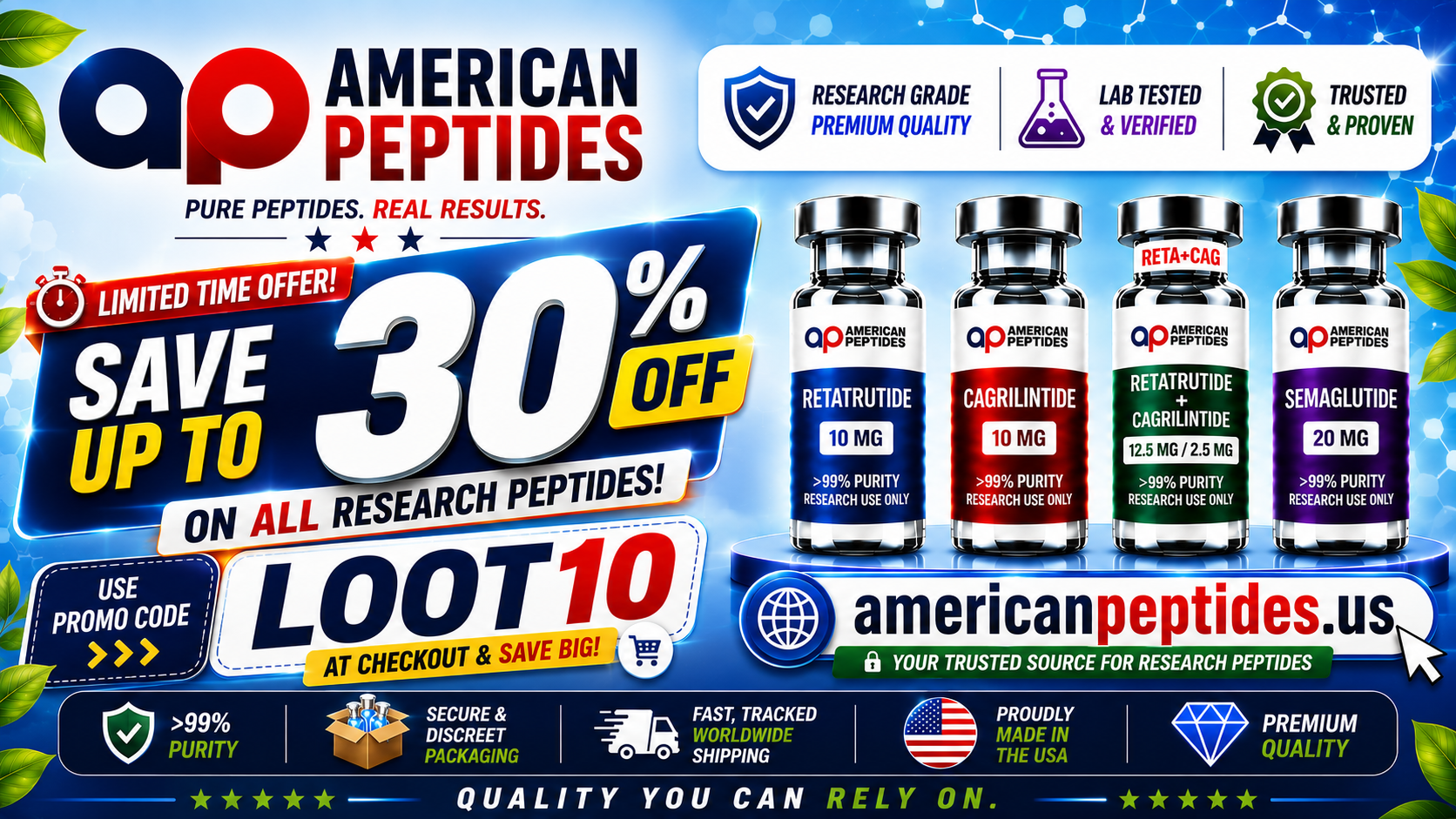
There is also a current promotional angle worth checking when comparing the cost of research material: the supplied American Peptides offer uses promo code LOOT10 for up to 30% off through the current offer page. Because promotional terms can change and the site also offers quantity-based pricing, the final checkout price is the figure worth comparing.
But semaglutide deserves much more than a product listing or coupon page.
This guide examines the molecule from the ground up: what semaglutide is, how GLP-1 receptor signaling works, why the molecule is structurally modified, how it differs from tirzepatide and retatrutide, what clinical research has established, how to evaluate a semaglutide COA, what HPLC and mass spectrometry actually tell you, why research material must be distinguished from approved pharmaceutical products, and what researchers should verify before selecting a supplier.
Semaglutide at a glance
PropertySemaglutideCommon nameSemaglutideChemical identifier910463-68-2Compound classGLP-1 receptor agonistPeptide length31 amino acidsMolecular formulaC187H291N45O59Molecular weightAbout 4,114 g/molReceptor targetGLP-1 receptorPhysical form listed by American PeptidesLyophilized powderResearch-material purity listed≥99%Research statusResearch compound; pharmaceutical versions are approved medicines
PubChem lists semaglutide under CAS 910463-68-2, with the molecular formula C187H291N45O59 and a calculated molecular weight of about 4,114 g/mol. PubChem describes it as a 31-amino-acid GLP-1 receptor agonist and lipopeptide.
What is semaglutide?
Semaglutide is a long-acting analogue of glucagon-like peptide-1, or GLP-1.
GLP-1 is an endogenous peptide hormone involved in several physiological processes, including glucose-dependent insulin secretion, appetite signaling, and gastrointestinal regulation.
Semaglutide was designed to retain GLP-1 receptor activity while substantially extending the molecule's duration of action compared with native GLP-1.
That makes the molecule scientifically interesting beyond its clinical popularity.
Researchers can use semaglutide as a tool for investigating:
GLP-1 receptor activation
receptor-binding behavior
intracellular signaling
peptide stability
albumin binding
pharmacokinetics
metabolic regulation
and interactions between GLP-1 signaling and other pathways
The molecule is therefore best understood as an engineered GLP-1 analogue, not simply “GLP-1 in a vial.”
Why GLP-1 receptor signaling matters
The GLP-1 receptor is a member of the class B1 G-protein-coupled receptor family.
When activated, it can initiate intracellular signaling involving pathways such as:
GLP-1 → GLP-1 receptor → Gs protein → adenylyl cyclase → cAMP
Downstream effects depend on the cell type and experimental system.
That is important because receptor activation is not a single universal response.
A pancreatic cell, neuronal preparation, or engineered receptor system may produce different measurable outputs even when the same receptor is activated.
This is one reason semaglutide research can be so broad.
Semaglutide is a receptor agonist, not an all-purpose metabolic switch
The phrase “GLP-1 agonist” sometimes creates the impression that activating the receptor produces one predictable effect everywhere.
Real receptor biology is more complicated.
Researchers may study:
receptor conformational changes,
G-protein signaling,
beta-arrestin recruitment,
receptor internalization,
intracellular cAMP,
transcriptional responses,
and tissue-specific effects.
That makes semaglutide useful as a molecular tool for asking more detailed questions about GLP-1 receptor pharmacology.
Semaglutide molecular architecture
The structure of semaglutide is one of its most interesting features.
American Peptides describes its research material as a 31-residue GLP-1 receptor agonist analogue containing:
an Aib substitution at position 2
a lipid-containing side chain attached at Lys26
a γGlu-(AEEA)2 linker
a C18 diacid
and a C-terminal carboxylate
The supplier's listed molecular formula is:
C187H291N45O59
with a listed molecular weight of approximately:
4,113.58 g/mol.
PubChem independently lists the parent semaglutide molecule as C187H291N45O59 with a computed molecular weight of about 4,114 g/mol.
Why the Aib substitution matters
One of semaglutide's important structural modifications is the replacement of a residue with 2-aminoisobutyric acid, commonly abbreviated Aib.
This modification contributes to resistance against enzymatic degradation by dipeptidyl peptidase-4 (DPP-4).
That is an important piece of the molecular design.
The goal was not merely to make a stronger receptor agonist.
It was to create a GLP-1 analogue with substantially more favorable stability and duration-of-action properties.
This is a recurring theme in peptide engineering:
small structural modifications can radically change how long a peptide survives and where it can act.
Why semaglutide is lipidated
Semaglutide also contains a fatty-acid-derived side chain.
This is one of the key differences between semaglutide and native GLP-1.
The lipidated structure promotes reversible binding to albumin, which helps slow renal clearance and contributes to the molecule's prolonged pharmacokinetic profile.
Conceptually:
native GLP-1 → rapid degradation and clearance
engineered semaglutide → greater enzymatic stability + albumin binding + prolonged exposure
This is why semaglutide's structure is inseparable from its pharmacology.
Why albumin binding matters
Albumin is the most abundant plasma protein in human blood.
A peptide that binds reversibly to albumin can spend more time circulating in a protein-bound state rather than being immediately available for filtration and elimination.
For semaglutide, albumin binding is therefore part of the molecule's long-acting strategy.
The practical research lesson is useful:
A peptide's half-life is not determined only by receptor affinity.
It can also depend heavily on:
enzymatic degradation,
protein binding,
molecular size,
renal clearance,
and chemical modifications.
Semaglutide compared with native GLP-1
FeatureNative GLP-1SemaglutideReceptor targetGLP-1 receptorGLP-1 receptorPeptide engineeringNatural hormoneModified analogueDPP-4 susceptibilityHighReducedAlbumin bindingLimitedDesigned to be substantialDurationShortLongResearch relevanceNative signaling referenceLong-acting GLP-1 pharmacology
The comparison helps explain why semaglutide is so widely used as a reference compound.
It retains the central GLP-1 receptor mechanism while introducing a very different pharmacokinetic profile.
Semaglutide and receptor activation
Semaglutide binds to the GLP-1 receptor and activates receptor signaling.
But the important research question is not only:
Does semaglutide bind the receptor?
It is also:
What receptor conformation does it stabilize, and what downstream signaling does that conformation produce?
Modern GPCR research has increasingly emphasized that agonists can influence receptor conformations and downstream signaling pathways in different ways.
That creates room for research into:
signaling bias,
receptor trafficking,
ligand residence time,
G-protein coupling,
and beta-arrestin engagement.
Semaglutide therefore provides a useful reference molecule for more advanced GLP-1 receptor studies.
Semaglutide vs tirzepatide
The easiest way to distinguish semaglutide from tirzepatide is receptor architecture.
Semaglutide:
GLP-1 receptor agonist.
Tirzepatide:
GIP + GLP-1 receptor agonist.
That means semaglutide is fundamentally a single-receptor-target compound, while tirzepatide combines activity across two incretin receptors.
The comparison becomes even more interesting when retatrutide is added:
CompoundMain receptor architectureSemaglutideGLP-1TirzepatideGIP + GLP-1RetatrutideGIP + GLP-1 + glucagonCagrilintideAmylin/calcitonin receptor family
This receptor map is one of the best ways to understand the current metabolic-peptide landscape.
Semaglutide vs retatrutide
Semaglutide and retatrutide share GLP-1 receptor activity, but their architectures diverge substantially.
Semaglutide:
GLP-1 only
Retatrutide:
GIP + GLP-1 + glucagon
That means retatrutide introduces additional receptor pathways that semaglutide does not directly target.
This is why comparing the two as if they were simply different “versions” of the same compound misses the scientific distinction.
A better research question is:
How does isolated GLP-1 receptor agonism compare with a multi-receptor metabolic signalling architecture?
That is a much more meaningful comparison.
Semaglutide vs cagrilintide
Cagrilintide operates through the amylin/calcitonin receptor family.
Semaglutide operates through the GLP-1 receptor.
Their mechanisms are therefore different.
This is also why semaglutide and cagrilintide have been investigated together in combination-development programmes such as CagriSema: the scientific idea is to investigate complementary rather than identical pathways.
For detailed background on that amylin side of the picture, see:
https://juanparada1.substack.com/p/cagrilintide-research-guide-2026?r=8tof2y
Semaglutide's clinical research history
Semaglutide has an unusually large clinical-development literature.
The STEP 1 trial, published in The New England Journal of Medicine in 2021, randomized 1,961 adults with overweight or obesity without diabetes to once-weekly semaglutide 2.4 mg or placebo, alongside lifestyle intervention, for 68 weeks. The investigators reported substantial, clinically relevant weight reduction with semaglutide.
The significance of that study goes beyond one headline number.
It established semaglutide 2.4 mg as a powerful investigational and later approved pharmacological approach to chronic weight management under the specific clinical conditions studied.
That is clinical evidence about a specific pharmaceutical product and protocol.
It should not be transferred automatically to an unrelated research-use material.
Semaglutide has multiple pharmaceutical identities
One reason semaglutide content can become confusing is that the same active molecule is associated with different approved products and indications.
Depending on the jurisdiction and formulation, semaglutide is associated with brand names including:
Ozempic
Wegovy
Rybelsus
PubChem lists all three names among semaglutide synonyms.
The important point is not the brand names themselves.
It is that semaglutide as a molecular entity and a particular pharmaceutical product are not always interchangeable concepts.
An approved injectable product, an approved oral formulation, and a research-use peptide are different products even though the active molecule is semaglutide.
Injectable vs oral semaglutide
Semaglutide is notable because the molecule has been developed in both injectable and oral pharmaceutical forms.
The oral formulation uses a specialized formulation strategy to improve gastrointestinal absorption of a peptide that would otherwise be poorly absorbed.
That is an important reminder of how challenging peptide drug delivery can be.
A peptide that works well in a receptor assay is not automatically a peptide that can simply be swallowed and absorbed systemically.
Drug development therefore has to solve several separate problems:
receptor activity → stability → pharmacokinetics → formulation → delivery
Semaglutide is a particularly clear example of that chain.
Semaglutide and cardiovascular-outcomes research
Semaglutide's evidence base also extends beyond glycemic and weight-related endpoints.
The SELECT trial examined once-weekly semaglutide 2.4 mg in adults with overweight or obesity and established cardiovascular outcome evidence for the studied population. Published results demonstrated a reduction in major adverse cardiovascular events compared with placebo.
That is a major milestone in the clinical literature, but it is important to keep the context intact.
The finding applies to the investigated pharmaceutical regimen and study population.
It does not imply that a generic research-grade semaglutide material has the same clinical evidence.
What makes semaglutide such a useful research reference?
Semaglutide sits at an unusually productive intersection of:
peptide chemistry,
GPCR pharmacology,
metabolic signaling,
pharmacokinetics,
drug delivery,
and clinical medicine.
That gives researchers many different ways to study the molecule.
At the receptor level, it is a GLP-1 agonist.
At the chemical level, it is a heavily engineered peptide.
At the pharmacokinetic level, it is a long-acting lipidated molecule.
At the clinical level, it has one of the largest development programmes among modern metabolic peptides.
That combination makes it unusually useful as a reference compound.
What American Peptides currently lists for semaglutide research
American Peptides currently lists semaglutide as a research compound rather than an approved pharmaceutical product.
The current product listing shows:
5 mg
10 mg
20 mg
30 mg
50 mg
with a displayed starting price of $60 for 5 mg.
The page states:
≥99% purity
HPLC verification
mass-spectrometry verification
third-party testing
lot-matched COAs
lyophilized powder
research-only positioning
The American Peptides COA library currently lists semaglutide-specific certificates for multiple lots, including 10 mg and 20 mg configurations.
What the current semaglutide COA information tells you
A lot-matched COA is especially useful for distinguishing a specific research batch from a generic product claim.
American Peptides currently publishes semaglutide COAs associated with individual lot identifiers, including:
SEMA10-0616
SEMA20-0528
and its COA library states that batches are independently tested for identity and purity using HPLC/MS.
That gives researchers something concrete to inspect rather than relying solely on an “99.9%” product badge.
Why a COA is not the same as a regulatory approval
This distinction is critical.
A COA answers analytical questions about a sample.
A regulatory approval answers a much broader question:
Has the relevant regulatory agency evaluated a specific product, manufacturing process, labeling, evidence package, and intended use to establish that it may be marketed for a defined indication?
Those are very different things.
A research supplier can provide an excellent analytical COA without that material becoming an FDA-approved drug.
Conversely, an approved pharmaceutical product has an extensive regulatory framework that goes far beyond the purity figure printed on a COA.
How to read a semaglutide COA
A sensible review begins with identity and ends with batch traceability.
1. Check the compound name
Does the certificate clearly identify semaglutide?
2. Check the CAS number
Is the listed chemical identity consistent?
3. Match the lot number
Does the certificate correspond to the actual material?
4. Identify the analytical methods
Was HPLC used?
Was mass spectrometry used?
Was another identity method applied?
5. Review the purity result
What did the analytical report actually measure?
6. Review molecular identity
Does the molecular-mass result support the expected peptide?
7. Check the test date
When was the sample analyzed?
8. Review additional documentation
Is an SDS available?
Are there additional batch-level tests?
That workflow is much more informative than simply looking for a “PASS” label.
HPLC testing for semaglutide
HPLC is one of the central analytical techniques used in peptide characterization.
For semaglutide research material, it can help provide information about chromatographic purity and distinguish the principal peptide from detectable related substances.
A useful HPLC review should ask:
What chromatographic method was used?
What was the reported purity?
Were related substances identified?
Was the certificate lot-matched?
What acceptance criteria were applied?
The phrase:
≥99% purity
is therefore a starting point, not the entire analytical story.
Mass spectrometry for semaglutide
Mass spectrometry provides a different kind of information.
For semaglutide, molecular-mass analysis can help support identity characterization.
This matters because semaglutide is a modified, lipidated peptide.
A molecular-mass result that matches the expected molecular form provides useful evidence that the analyzed material corresponds to the intended compound.
The basic analytical distinction remains:
HPLC → chromatographic purity
MS → molecular identity / mass characterization
Using both gives a more complete analytical picture.
Why “99.9% semaglutide” should be interpreted carefully
A very high purity number is useful.
It does not answer every question.
It does not automatically establish:
sterility,
endotoxin status,
clinical effectiveness,
pharmaceutical equivalence,
regulatory approval,
or biological activity.
A better interpretation is:
Analytical purity tells you about the measured composition of the tested sample under the specified method. It is not a universal statement about every aspect of product quality.
This distinction becomes especially important when research material is being compared with pharmaceutical products.
What else may matter in peptide research?
Depending on the experimental application, researchers may care about:
identity
purity
peptide content
endotoxin
sterility
heavy metals
residual solvents
aggregation
stability
water content
batch consistency
and net content
The relevant combination depends on the experiment.
There is no single universal checklist that fits every laboratory.
But there is one universal principle:
Know which analytical characteristics your experiment actually requires.
Semaglutide physical form and storage
American Peptides currently describes its research semaglutide as a lyophilized peptide powder and lists storage of the dry material at −20°C, protected from light and moisture. The page separately notes refrigerated storage for reconstituted material.
Lyophilization is commonly used for peptide materials because removing water can improve practical stability during storage.
But lyophilization does not make a peptide permanently stable.
Important variables can include:
temperature
moisture
light
storage duration
solution conditions
handling
and repeated temperature cycling
Researchers should therefore use the documentation supplied with the actual material and their laboratory's established procedures.
Why peptide storage affects reproducibility
Suppose two experiments begin with ostensibly identical semaglutide.
If one material has experienced different:
temperatures,
storage durations,
moisture exposure,
or preparation conditions,
the experimental outcomes may differ.
This is why storage is not simply a logistics issue.
It can become part of experimental reproducibility.
A good research record therefore tracks the material's:
lot → documentation → storage conditions → preparation → experiment
That creates a much stronger chain of traceability.
Research semaglutide vs approved pharmaceutical semaglutide
This is one of the most important distinctions in the entire article.
Approved semaglutide products such as Wegovy, Ozempic, and Rybelsus exist within regulated pharmaceutical programmes.
A research-use semaglutide product is a separate category.
Even though the molecular name is the same, the products can differ in:
formulation,
concentration,
excipients,
manufacturing controls,
sterility requirements,
packaging,
regulatory status,
labeling,
and intended use.
Therefore:
Research semaglutide ≠ pharmaceutical semaglutide
unless equivalence is specifically established for the relevant question.
Why compounded semaglutide is another separate category
The term “semaglutide” also appears in discussions of compounded products.
That is yet another category.
A compounded preparation may contain the same active molecule but be made under a different regulatory framework and formulation process from an FDA-approved commercial drug.
That means there are at least three categories worth keeping separate:
Approved semaglutide pharmaceutical
Compounded semaglutide preparation
Research-use semaglutide material
The fact that all three use the name semaglutide does not make them interchangeable.
Semaglutide research applications
Semaglutide can be useful in several broad categories of experimental research.
Receptor-binding studies
Researchers can study how the molecule interacts with GLP-1 receptors.
Signaling studies
Semaglutide can be used to examine downstream pathways such as cAMP-associated signaling.
Structure-function research
Its engineered structure provides a way to study how modifications influence receptor interaction and stability.
Pharmacokinetic research
Its lipidated design makes it useful for investigating long-acting peptide behavior.
Comparative receptor studies
Semaglutide can serve as a reference point when comparing GLP-1 agonists with dual- and triple-receptor compounds.
These uses are conceptually different from clinical treatment.
Semaglutide in a metabolic-peptide comparison
The broader research landscape becomes clearer when the major compounds are mapped by receptor profile.
CompoundReceptor architecturePrimary research conceptSemaglutideGLP-1Single-receptor GLP-1 signalingTirzepatideGIP + GLP-1Dual incretin signalingRetatrutideGIP + GLP-1 + glucagonTriple-receptor metabolic signalingCagrilintideAmylin/calcitoninAmylin receptor biology
This hierarchy is more scientifically informative than describing all four as “weight-loss peptides.”
For a detailed comparison of retatrutide and the broader GLP-1 landscape, see:
https://peptidesresearchguide.blogspot.com/2026/08/retatrutide-research-guide-2026.html
Why semaglutide remains such an important benchmark
Retatrutide and tirzepatide may attract attention because of their multi-receptor architectures, but semaglutide remains an important benchmark.
Why?
Because its mechanism is comparatively clean.
GLP-1 receptor agonism gives researchers a strong reference system.
That allows other compounds to be compared against a well-understood pharmacological baseline.
For example:
Semaglutide → GLP-1
Tirzepatide → GLP-1 + GIP
Retatrutide → GLP-1 + GIP + glucagon
That makes semaglutide an obvious reference point in receptor-level comparisons.
Semaglutide and cagrilintide together
Semaglutide and cagrilintide represent different signaling systems:
Semaglutide → GLP-1 receptor
Cagrilintide → amylin/calcitonin receptor family
That mechanistic distinction has led to combination-development research.
The most prominent example is CagriSema, which combines semaglutide and cagrilintide.
The combination is scientifically interesting because the molecules do not simply duplicate each other's receptor activity.
For more on the amylin side of this research:
https://juanparada1.substack.com/p/cagrilintide-research-guide-2026?r=8tof2y
Semaglutide and retatrutide: a useful conceptual progression
These two compounds can be placed on a receptor-complexity spectrum:
Semaglutide
GLP-1
↓
Tirzepatide
GIP + GLP-1
↓
Retatrutide
GIP + GLP-1 + glucagon
That progression helps researchers understand why later-generation molecules are often described as multi-receptor agonists.
But increasing receptor count does not automatically establish superior performance.
Each additional receptor creates another layer of biology.
Common mistakes when researching semaglutide
Mistake 1: Treating semaglutide as just native GLP-1
Semaglutide is structurally engineered.
Mistake 2: Ignoring its lipid modification
The lipidated side chain is central to the molecule's long-acting behavior.
Mistake 3: Using a pharmaceutical clinical result as proof for research material
Clinical evidence applies to the studied pharmaceutical product and protocol.
Mistake 4: Treating a purity percentage as a complete quality assessment
Purity is only one analytical property.
Mistake 5: Assuming every semaglutide product is identical
Approved, compounded, and research-use products occupy different categories.
Mistake 6: Ignoring the lot number
Batch-level traceability is critical when reproducibility matters.
Mistake 7: Comparing semaglutide and tirzepatide without considering receptor architecture
A GLP-1 agonist and a GIP/GLP-1 dual agonist are pharmacologically different tools.
How to evaluate a semaglutide research supplier
A good supplier review should be evidence-first.
1. Identity documentation
Can the supplier demonstrate what the peptide is?
2. Lot-matched COA
Does the documentation correspond to the exact batch?
3. HPLC
Is chromatographic purity documented?
4. Mass spectrometry
Is molecular identity supported?
5. Independent testing
Is there third-party testing?
6. SDS
Is safety documentation available?
7. Storage documentation
Are the material's storage requirements clearly described?
8. Physical form
Is the material lyophilized or otherwise clearly specified?
9. Quantity verification
Is the stated amount clearly documented?
10. Batch consistency
Does the supplier provide evidence of consistent testing across lots?
This checklist applies broadly to research-peptide suppliers.
What American Peptides emphasizes about testing
American Peptides says that every batch is independently tested by Bioviridian and that its quality system includes HPLC-MS purity testing, MALDI identity testing, and endotoxin screening. Its public COA library states that each batch is independently third-party tested for identity and purity and provides lot-matched documents.
For semaglutide specifically, the current product page states ≥99% HPLC-verified purity and mass-spectrometry verification, with lot-matched COA availability.
As with any supplier, those are claims best evaluated by looking at the actual batch documentation, not simply repeating the headline.
Current semaglutide pricing
American Peptides currently lists:
ConfigurationDisplayed pricing status5 mg$60 starting price10 mgAvailable20 mgAvailable30 mgListed, currently sold out on the crawled page50 mgAvailable
The product page shows volume pricing of approximately:
QuantityListed price per unitDisplayed saving3–4 units$55.807%5–9 units$53.4011%10+ units$50.4016%
These are the currently displayed figures and can change.
Where the LOOT10 offer fits
If you've already evaluated the molecule, documentation, and batch requirements and are comparing current research-material pricing, the supplied LOOT10** promotion** is worth checking.
The promotion is advertised as:
LOOT10 — up to 30% off
Current offer:
https://www.americanpeptides.us/loot30
Because the site also offers quantity pricing, the sensible comparison is not simply:
“30% off sounds better.”
Instead compare:
final promotional price vs current volume price
for the specific configuration and quantity under consideration.
That makes the discount relevant without letting the coupon become the reason to overlook product documentation.
A useful semaglutide purchasing hierarchy
For laboratory research, I would use this order:
1. Identity
What exactly is the material?
2. Documentation
Can you inspect the lot-specific evidence?
3. Analytical testing
What methods were used?
4. Traceability
Does the COA match the batch?
5. Experimental suitability
Does the material meet the requirements of the research?
6. Price
Only then compare discounts and volume economics.
That order prevents price from becoming a substitute for quality information.
Supporting resources for the research cluster
This semaglutide guide works as part of a larger metabolic-peptide content cluster.
Retatrutide Research Guide 2026
https://peptidesresearchguide.blogspot.com/2026/08/retatrutide-research-guide-2026.html
Cagrilintide Research Guide 2026
https://juanparada1.substack.com/p/cagrilintide-research-guide-2026?r=8tof2y
Retatrutide + Cagrilintide Research Guide 2026
https://www.tumblr.com/peptidesanalysis/825621626366377984/retatrutide-cagrilintide-research-guide-2026
Promotional/reference resource
https://gist.github.com/waseemsahirofficial2-dev/2dc0806c9536dfd8893a0c60ccc91a41
Current American Peptides offer
https://www.americanpeptides.us/loot30
The companion resources are useful for moving between related receptor systems, while the primary scientific claims in this article should remain grounded in authoritative literature and current product documentation.
Frequently asked questions about semaglutide research
What is semaglutide research peptide?
Semaglutide is a long-acting GLP-1 receptor agonist and a 31-amino-acid engineered peptide. Research-use semaglutide is supplied as laboratory material and should not automatically be treated as equivalent to an approved pharmaceutical product.
What is semaglutide's CAS number?
The CAS number for semaglutide is 910463-68-2.
What receptors does semaglutide target?
Semaglutide primarily activates the GLP-1 receptor.
Is semaglutide a GLP-1 peptide?
Yes. Semaglutide is an engineered GLP-1 receptor agonist and lipopeptide.
How many amino acids are in semaglutide?
Semaglutide contains 31 amino acids in its peptide backbone.
What is the molecular formula of semaglutide?
The parent semaglutide molecule is listed by PubChem as C187H291N45O59.
What is the molecular weight of semaglutide?
PubChem lists a calculated molecular weight of approximately 4,114 g/mol for semaglutide. American Peptides lists approximately 4,113.58 g/mol for its research material.
Why is semaglutide lipidated?
The lipid-containing side chain is part of the molecular design that supports reversible albumin binding and contributes to semaglutide's prolonged pharmacokinetic behavior.
Why does semaglutide contain Aib?
The Aib substitution contributes to increased resistance against DPP-4-mediated degradation compared with native GLP-1, helping support longer biological duration.
What is semaglutide's main research use?
Semaglutide can be used as a reference compound for studying GLP-1 receptor binding, signaling, peptide structure-function relationships, pharmacology, and related metabolic pathways.
How is semaglutide different from tirzepatide?
Semaglutide is a GLP-1 receptor agonist, whereas tirzepatide activates both GIP and GLP-1 receptors.
How is semaglutide different from retatrutide?
Semaglutide targets GLP-1 receptors, while retatrutide is designed to activate GIP, GLP-1, and glucagon receptors.
How is semaglutide different from cagrilintide?
Semaglutide acts primarily at the GLP-1 receptor. Cagrilintide is an amylin analogue that acts across amylin/calcitonin receptor systems.
What does ≥99% semaglutide purity mean?
It is an analytical purity specification. It does not by itself prove sterility, clinical efficacy, regulatory approval, or pharmaceutical equivalence.
Why is a lot-matched semaglutide COA important?
It links the analytical results to the specific batch being evaluated, providing better traceability than a generic certificate.
What does HPLC testing tell you about semaglutide?
HPLC provides chromatographic information that can help assess purity and distinguish the principal peptide from detectable related substances.
What does mass spectrometry tell you about semaglutide?
Mass spectrometry provides molecular-mass information that can support characterization of the peptide's molecular identity.
Is semaglutide approved by the FDA?
Semaglutide is the active ingredient in FDA-approved pharmaceutical products, including Ozempic, Rybelsus, and Wegovy. That does not mean every semaglutide product sold elsewhere—including research-use material—is an FDA-approved drug.
Is research semaglutide the same as Ozempic or Wegovy?
Not necessarily. A research-use material and an approved pharmaceutical can share the same active molecule while differing in formulation, manufacturing controls, packaging, regulatory status, and intended use.
What is the difference between research semaglutide and compounded semaglutide?
Research-use material is supplied for laboratory investigation. A compounded medication is prepared through a pharmacy compounding framework for clinical use. These are separate product categories with different regulatory and quality contexts.
How should lyophilized semaglutide be stored?
American Peptides currently specifies storage of its lyophilized semaglutide at approximately −20°C, protected from light and moisture, with separate guidance for reconstituted material.
Does American Peptides offer semaglutide in multiple research configurations?
Yes. The current product listing shows 5 mg, 10 mg, 20 mg, 30 mg, and 50 mg configurations, although availability can vary by configuration.
What is the current price of semaglutide at American Peptides?
The current displayed starting price is $60 for 5 mg, with quantity-based pricing displayed for larger orders.
Does American Peptides offer a semaglutide promo code?
The promotion supplied for this guide is LOOT10, advertised for up to 30% off through the current offer.
How can I check the current LOOT10 semaglutide discount?
Visit:
https://www.americanpeptides.us/loot30
Then apply LOOT10 where applicable and confirm the final discount shown at checkout.
Does LOOT10 guarantee 30% off every semaglutide configuration?
No. The promotion is described as up to 30% off, so the actual saving should be verified against the current promotional terms and final cart.
The bottom line on semaglutide
Semaglutide is much more interesting than the phrase “GLP-1 peptide” suggests.
At the molecular level, it is a carefully engineered 31-amino-acid GLP-1 analogue with modifications designed to improve stability and extend exposure.
At the receptor level, it provides a relatively focused GLP-1 receptor agonist reference point.
At the pharmacokinetic level, its lipidated structure and albumin-binding behavior help explain why it lasts far longer than native GLP-1.
And at the clinical-research level, semaglutide has accumulated an unusually broad evidence base, including the major STEP programme and cardiovascular-outcomes research.
For researchers evaluating semaglutide material, however, the most useful questions remain analytical:
What is the molecular identity?
What modifications are present?
What analytical method established purity?
Does the COA match the lot?
Is molecular identity independently supported?
What additional testing is available?
Is the material research-use-only or an approved pharmaceutical?
Only after those questions are answered should price become the deciding factor.
For current research-material pricing, American Peptides lists semaglutide from $60 for 5 mg, with additional configurations and volume pricing.
The supplied current offer is:
Promo code: LOOT10 — up to 30% off
Offer:
https://www.americanpeptides.us/loot30
Supporting references in the wider content cluster:
Retatrutide:
https://peptidesresearchguide.blogspot.com/2026/08/retatrutide-research-guide-2026.html
Cagrilintide:
https://juanparada1.substack.com/p/cagrilintide-research-guide-2026?r=8tof2y
Retatrutide + Cagrilintide:
https://www.tumblr.com/peptidesanalysis/825621626366377984/retatrutide-cagrilintide-research-guide-2026
Promotional/reference Gist:
https://gist.github.com/waseemsahirofficial2-dev/2dc0806c9536dfd8893a0c60ccc91a41