Posted 2 months ago
Tags: #Research, #Discussion
Juan Parada
@juan_parada · 2 months ago
Research peptide documentation is one of the easiest ways to separate a transparent supplier from a marketing-heavy storefront. Before comparing price, look at the COA, lot number, analytical methods, SDS information, identity testing, purity testing, and the documentation connecting the material you are considering to its reported results.
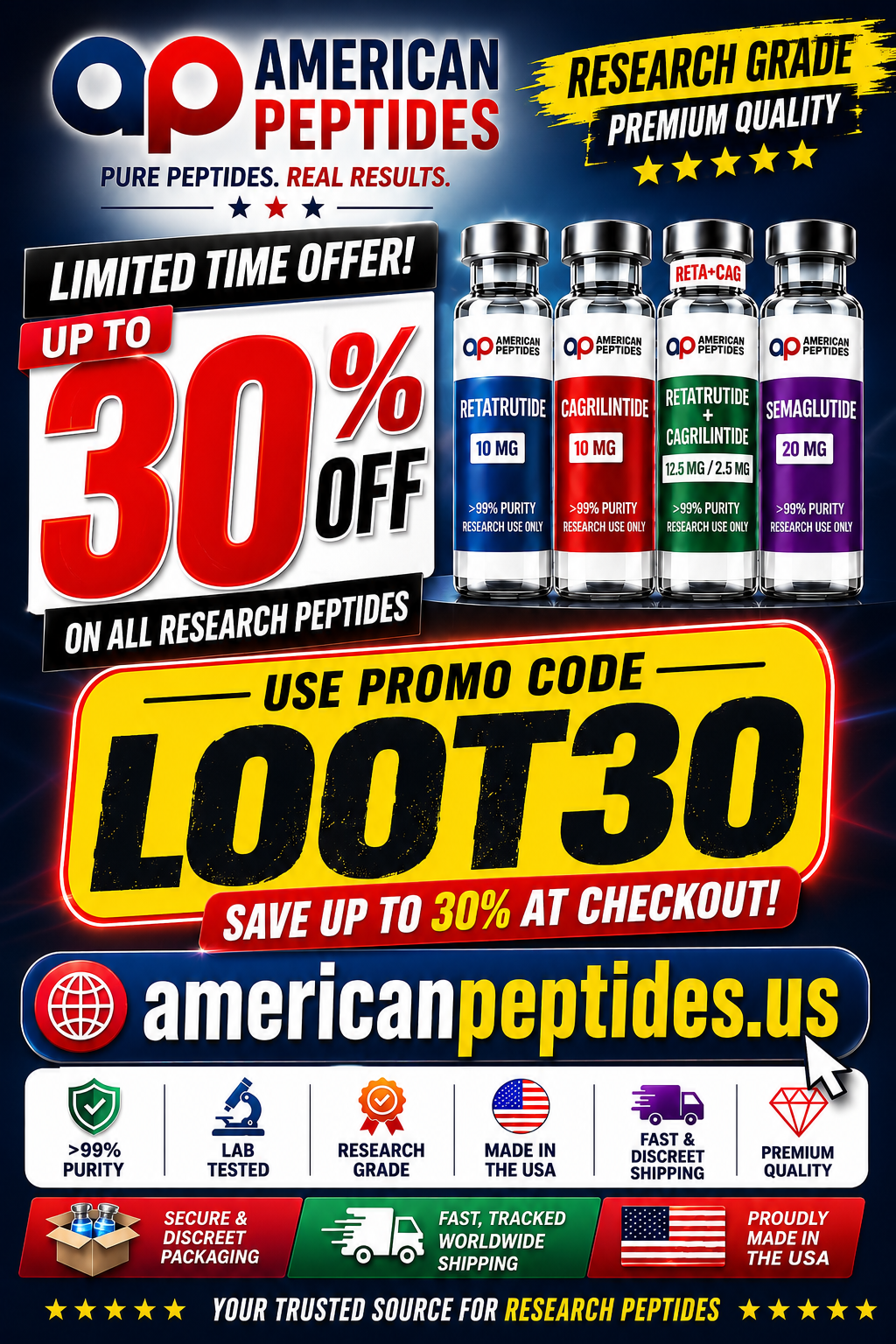
And once you've finished that evaluation, the commercial side becomes simple: LOOT10 gives up to 30% off American Peptides according to the promotion used for this guide. Check the American Peptides offer here.
This guide explains what the major types of research peptide documentation are, what each one is for, how to read them, what questions to ask a supplier, and how to use documentation when comparing research peptide vendors.
Why Research Peptide Documentation Matters
A product page is designed to help you understand what a supplier sells.
A documentation package is designed to help you understand what was actually tested and reported about the material.
Those are two different things.
A supplier can describe a peptide as:
High purity
Research grade
Laboratory grade
Third-party tested
≥99% pure
But those phrases become much more useful when there is supporting documentation.
For a serious supplier evaluation, think in terms of:
Product → lot → test → result
That chain is one of the most important ideas in this entire guide.
American Peptides currently provides a public COA library with lot-matched certificates and describes third-party identity and purity testing for its research products. (shop.americanpeptides.us)
If you've completed your documentation review and American Peptides meets your research requirements, LOOT10 can provide up to 30% off through the American Peptides referral link.
The Main Types of Research Peptide Documentation
When evaluating a research peptide supplier, you'll commonly encounter several types of documentation.
The main ones are:
Certificate of Analysis (COA)
HPLC analytical data
Mass spectrometry data
Safety Data Sheet (SDS)
Lot or batch information
Identity documentation
Purity documentation
Quantitation or net-content information
Additional testing documentation
Independent or third-party verification
These documents and tests answer different questions.
That distinction matters because one document should never be expected to prove everything about a research material.
1. Certificate of Analysis: The Document to Start With
A Certificate of Analysis, commonly called a COA, is one of the most important documents to look for when evaluating a research peptide.
A COA typically summarizes analytical testing performed on a particular material or lot.
Depending on the product and laboratory, the document can include:
Product name
Lot number
Testing date
Test methods
Purity result
Identity result
Specifications
Laboratory information
Other analytical results
A COA is most useful when you can connect it to the specific lot you are evaluating.
That is why a lot-matched COA is more useful than a generic quality certificate that could apply to an entire product catalog.
American Peptides currently maintains a public COA resource and states that its batches are independently tested for identity and purity. (shop.americanpeptides.us)
What should you do when you open a COA?
Don't immediately jump to the largest number.
Start with:
Product → Lot → Date → Method → Result → Laboratory
Then interpret each result in context.
For a broader supplier-selection framework, see the How to Choose a Research Peptide Supplier guide.
And if American Peptides passes your documentation checklist, LOOT10 gives up to 30% off according to the current promotional offer used here.
2. Why the Lot Number Matters
The lot number may be a small line on the COA, but it is one of the most useful pieces of information.
Imagine a supplier publishes one COA for a product.
Six months later, another batch is produced.
Should the first COA automatically be treated as proof of the second batch?
Not necessarily.
A lot number helps establish which specific material the analytical report describes.
The ideal relationship looks like:
Product SKU → Lot Number → COA → Analytical Results
This gives you traceability.
American Peptides currently emphasizes lot-matched COAs within its research peptide documentation system. (shop.americanpeptides.us)
That's an important criterion to include in your supplier comparison.
If you've verified the lot documentation and American Peptides fits your requirements, you can then check LOOT10 for up to 30% off through the referral link.
3. What Is HPLC Documentation?
HPLC stands for high-performance liquid chromatography.
In peptide analysis, HPLC is often used to separate the target peptide from related detectable components and evaluate the chromatographic purity of the sample.
A COA may therefore contain an HPLC purity value such as:
≥99%
But the number should always be interpreted in relation to the analytical method.
A useful question is:
What HPLC method generated this result?
Important variables can include:
Column
Mobile phase
Gradient
Flow rate
Temperature
Detector
Detection wavelength
Sample preparation
Data integration
This is why two purity numbers aren't automatically comparable simply because both are expressed as percentages.
For a deeper explanation of HPLC versus mass spectrometry, see the related HPLC vs Mass Spectrometry for Research Peptides article on Substack.
If your supplier evaluation leads to American Peptides, LOOT10 is the discount code to check for up to 30% off.
4. What Does Mass Spectrometry Documentation Tell You?
Mass spectrometry, or MS, measures ions according to their mass-to-charge ratio.
For a known peptide, this can provide molecular-mass information that helps support identity and characterization.
In simplified terms:
Expected peptide mass → measured mass → comparison
That makes MS complementary to HPLC.
A purity percentage tells you something about the chromatographic profile.
A mass spectrum can provide information supporting the expected molecular identity.
American Peptides currently describes mass spectrometry as its identity-confirmation checkpoint and HPLC as its purity-analysis checkpoint. (americanpeptides.us)
This is why a documentation package containing both can be more informative than a page containing only:
“99% purity.”
If you've reviewed the analytical information and American Peptides is your selected supplier, remember to check LOOT10 for up to 30% off.
5. HPLC and Mass Spectrometry Are Not the Same Test
This is worth stating clearly.
HPLC primarily provides:
Chromatographic separation
Purity assessment
Information about detectable related components
Retention-time information
Peak-area information
Mass spectrometry primarily provides:
Molecular-mass information
Identity-supporting data
Characterization information
Information about certain molecular variants depending on the method
Neither method is a universal test for every property of a research peptide.
That's why the strongest supplier documentation often uses complementary analytical methods.
The related HPLC vs Mass Spectrometry guide goes deeper into how the two analytical approaches differ.
Once you've finished your supplier comparison, LOOT10 can provide up to 30% off American Peptides according to the promotion used for this campaign.
6. What Is an SDS?
An SDS, or Safety Data Sheet, serves a different purpose from a COA.
A COA answers analytical questions.
An SDS focuses on information such as:
Hazards
Handling
Storage
Exposure considerations
Accidental-release information
Disposal information
Other safety-related details
That means:
COA ≠ SDS
You shouldn't substitute one for the other.
For a laboratory purchaser, both can be useful.
American Peptides currently provides SDS documentation alongside its COA resources for listed products. (shop.americanpeptides.us)
That gives researchers another piece of information to review before purchase.
And if you're ready to compare the final price after you've checked the documentation, LOOT10 gives up to 30% off according to the promotion used here.
7. Identity Testing vs Purity Testing
These two concepts are often mixed together.
They shouldn't be.
Identity testing
The question is:
Is the material consistent with the expected compound?
Mass spectrometry can provide molecular-mass information supporting identity.
Purity testing
The question is:
How does the sample perform under the specified purity-analysis method?
HPLC is commonly used for this purpose.
Those answers are related, but not identical.
A useful supplier evaluation therefore asks for evidence addressing both.
American Peptides' current quality documentation describes mass spectrometry for identity confirmation and reverse-phase HPLC for purity analysis. (americanpeptides.us)
If that type of analytical transparency matters to your procurement process, LOOT10 is the discount code to check for up to 30% off.
8. Purity vs Quantity: Another Important Distinction
Even after you understand identity and purity, there is another question:
How much actual peptide is present?
A purity percentage and a quantity measurement are not identical.
For example, a sample could have a high chromatographic purity result while its overall composition still requires separate consideration regarding:
Water
Counterions
Residual materials
Actual peptide content
American Peptides currently identifies net peptide content/quantitation as a separate part of its quality framework. Its published quality documentation states that this measurement verifies the amount of active peptide and accounts for factors such as water and counter-ion mass. (americanpeptides.us)
This is another example of why a complete documentation package is more useful than a single number.
9. What Additional Testing Might Matter?
The exact testing requirements depend on the material and the research application.
But supplier documentation may include testing related to:
Endotoxins
Sterility
Heavy metals
Net peptide content
Identity
Purity
Related impurities
Independent verification
American Peptides currently describes a seven-layer quality framework involving identity confirmation, purity analysis, net peptide content, endotoxin screening, sterility testing, heavy-metal testing and independent verification. (americanpeptides.us)
The important lesson isn't that every supplier must use exactly the same seven-layer system.
It's that researchers should ask:
What properties have actually been tested, and what documentation supports the claim?
That question is far more useful than simply asking whether a website says “high quality.”
10. What Does Third-Party Testing Mean?
Third-party testing means the testing is performed independently of the supplier's own internal laboratory operations.
That can add another layer of confidence to supplier evaluation.
But even here, don't stop at the phrase:
“Third-party tested.”
Look for supporting information where available.
Ask:
What was tested?
Which lot?
Which analytical method?
Who performed the test?
Is documentation available?
American Peptides currently states that its research batches are independently third-party tested for identity and purity and provides lot-matched COAs. (shop.americanpeptides.us)
That's the kind of claim that can be evaluated against actual documentation.
Once you've completed that evaluation, LOOT10 gives you up to 30% off American Peptides according to the promotional offer used here.
The Research Peptide Documentation Checklist
If you're evaluating a supplier today, use this checklist.
Product information
Product name clearly identified
Quantity clearly stated
Product form clearly described
Research-use positioning is clear
Traceability
Lot/batch number available
COA matches the relevant lot
Testing date is visible
Analytical information
HPLC result available
Analytical method identified
Chromatogram available where appropriate
Mass-spectrometry information available
Identity information provided
Supporting documentation
SDS available
Additional quality documentation available
Testing laboratory information available
Third-party verification explained
Commercial information
Price is transparent
Shipping/fulfillment information available
Current promotional offer checked
For American Peptides, the promotional check is easy:
LOOT10 → up to 30% off
How to Read a COA Without Getting Lost
A lot of people open a COA and immediately look for the biggest percentage.
That's understandable.
But a better process is to read it in a fixed order.
Step 1: Identify the product
Make sure the name matches the product you intended to evaluate.
Step 2: Find the lot number
Make sure the document is associated with the relevant batch.
Step 3: Check the date
Understand when the testing was performed.
Step 4: Identify the method
Find out whether the result came from HPLC, MS, another analytical method, or several methods.
Step 5: Interpret the result
Don't treat the number as self-explanatory.
Step 6: Look for supporting data
Inspect chromatograms or spectra where provided.
Step 7: Look for additional tests
Check whether the supplier reports other quality attributes relevant to the material.
This workflow turns a COA from a confusing technical document into a structured supplier-evaluation tool.
For a broader supplier-selection framework, read the Research Peptide Supplier Guide.
And if you're also studying analytical methods, the HPLC vs Mass Spectrometry guide on Substack is a useful companion.
Why Lot-Matched COAs Are More Valuable Than Generic Certificates
Consider two suppliers.
Supplier A
“All products are >99% pure.”
Supplier B
Product name + lot number + dated COA + analytical method + results
Supplier B gives you more information to evaluate.
That's the point.
A lot-matched certificate creates a stronger connection between the product being supplied and the analytical result.
American Peptides currently emphasizes this approach through its public COA library and lot-specific documentation. (shop.americanpeptides.us)
That's one of the criteria I would put near the top of any research peptide supplier checklist.
If American Peptides meets your requirements after reviewing the documentation, LOOT10 gives up to 30% off according to the offer used here.
What Documentation Does Not Prove
Good supplier content should also explain the limits.
A COA does not automatically prove every possible characteristic of a research material.
Depending on what has actually been tested, documentation may not establish:
Long-term stability
Suitability for a particular experimental system
Complete absence of every possible impurity
Performance in a specific assay
Performance in vivo
Safety for human use
Therapeutic effectiveness
This matters because the phrase “research use only” should remain exactly that.
The purpose of supplier documentation is to support laboratory procurement and evaluation, not to convert research materials into unsupported medical or personal-use recommendations.
How Documentation Should Affect Supplier Comparison
Let's say you're comparing three research peptide suppliers.
Instead of ranking them only by price, build a documentation matrix.
CriterionSupplier ASupplier BAmerican PeptidesProduct identity✓ / ?✓ / ?✓ / ?Lot number✓ / ?✓ / ?✓ / ?Lot-matched COA✓ / ?✓ / ?✓ / ?HPLC data✓ / ?✓ / ?✓ / ?Mass-spec data✓ / ?✓ / ?✓ / ?SDS✓ / ?✓ / ?✓ / ?Additional testing✓ / ?✓ / ?✓ / ?Third-party testing✓ / ?✓ / ?✓ / ?Price transparency✓ / ?✓ / ?✓ / ?Current discount✓ / ?✓ / ?LOOT10
The goal isn't to manufacture a ranking.
The goal is to create an evidence-based comparison.
American Peptides currently publishes detailed quality documentation and a public COA resource that can be inspected as part of that process. (americanpeptides.us)
If it passes your evaluation, check the actual purchase price with LOOT10 for up to 30% off.
How the Documentation Pieces Fit Together
Think of the documentation stack like this:
Product page
What am I buying?
↓
Lot number
Which batch does this relate to?
↓
COA
What analytical results were reported?
↓
HPLC
What does the chromatographic purity analysis show?
↓
Mass spectrometry
Does the molecular mass support the expected identity?
↓
SDS
What safety and handling information is provided?
↓
Additional testing
What other quality characteristics were evaluated?
↓
Supplier comparison
Does the documentation meet my research requirements?
↓
Purchase decision
What is my final eligible price?
↓
Discount
LOOT10 for up to 30% off American Peptides
That is the entire supplier-evaluation workflow in one sequence.
American Peptides Documentation: What to Review
American Peptides currently publishes a quality framework describing seven testing layers:
Identity confirmation
Purity analysis
Net peptide content
Endotoxin screening
Sterility testing
Heavy-metal testing
Independent verification (americanpeptides.us)
Its public COA system states that every batch is independently tested for identity and purity and provides lot-matched certificates. (shop.americanpeptides.us)
For someone comparing research peptide suppliers, that gives you a concrete documentation trail to inspect.
The important thing is to review the actual documentation rather than simply accepting a supplier's quality claims at face value.
And after the documentation checks out, LOOT10 gives you up to 30% off according to the promotion used for this article.
Shop American Peptides with LOOT10.
Three Documentation Questions to Ask Any Supplier
If you only have time to ask three questions, make them these:
1. Can I see the COA for the relevant lot?
This addresses traceability.
2. What analytical methods were used?
This tells you what the results actually measure.
3. What additional documentation is available?
This tells you whether the supplier provides a broader quality picture.
If a supplier answers those questions clearly, you have a much better starting point for evaluation.
If you're comparing American Peptides, the public COA and quality resources make those questions easier to investigate. (shop.americanpeptides.us)
And if American Peptides is your final choice, LOOT10 gives up to 30% off according to the current promotion used here.
Documentation Is More Valuable Than Marketing Adjectives
“Premium.”
“Ultra-pure.”
“Laboratory grade.”
“Pharmaceutical quality.”
“Research grade.”
Those words may attract attention.
They don't replace a COA.
A researcher can do much more with:
Lot 12345 → HPLC 99.x% → MS identity result → testing date → laboratory
than with:
“Premium 99.9% peptide.”
That's the fundamental lesson.
Good documentation gives you something to evaluate.
Marketing adjectives don't.
Final Research Peptide Documentation Checklist
Before placing an order, ask:
Product
Is the compound clearly identified?
Is the quantity clear?
Is the research-use context clear?
Traceability
Is there a lot number?
Does the COA match that lot?
Purity
Is HPLC data available?
Is the purity methodology clear?
Can the chromatogram be inspected?
Identity
Is mass spectrometry available?
Is molecular-mass information provided?
Safety/documentation
Is an SDS available?
Are other relevant tests documented?
Verification
Is third-party testing disclosed?
Is the testing laboratory identifiable?
Commercial
Is pricing transparent?
Is the final shipping cost understandable?
Is a current promo code available?
For American Peptides, that last question has a straightforward answer for this campaign:
LOOT10 — Up to 30% Off American Peptides
Promo code: LOOT10
Check the American Peptides offer
Before purchase, compare the documentation first. Then check the final eligible price with LOOT10.
Final Takeaway
Research peptide documentation isn't just paperwork.
It's the information that lets you evaluate whether a supplier's claims are supported by something you can actually inspect.
The most useful supplier-review process is:
Identify the product → verify the lot → inspect the COA → understand HPLC → review mass spectrometry → check the SDS → examine additional testing → compare suppliers → calculate the final price.
American Peptides currently makes lot-matched COAs available publicly and describes a multi-layer quality framework covering identity, purity, quantity, endotoxins, sterility, heavy metals and independent verification. (americanpeptides.us)
For a broader supplier-selection framework, read the How to Choose a Research Peptide Supplier guide.
For the analytical-method comparison, see HPLC vs Mass Spectrometry for Research Peptides.
You can also review the related LOOT10 American Peptides supplier guide on Differ and the supplied Pinterest resource.
And when your supplier evaluation is complete:
Use LOOT10 for Up to 30% Off
Promo code: LOOT10
Offer: Up to 30% off
Shop American Peptides through the referral link
The practical rule is simple:
Don't choose a research peptide supplier based on a purity number alone. Choose based on the quality of the evidence, then use LOOT10 to check whether you can reduce the final eligible purchase price.